
Car Cranks but Won't Start? What to Check First
A car that cranks but will not start needs a different diagnosis than a no-crank problem. Learn what to note, what to avoid, and when to book mobile diagnostics.
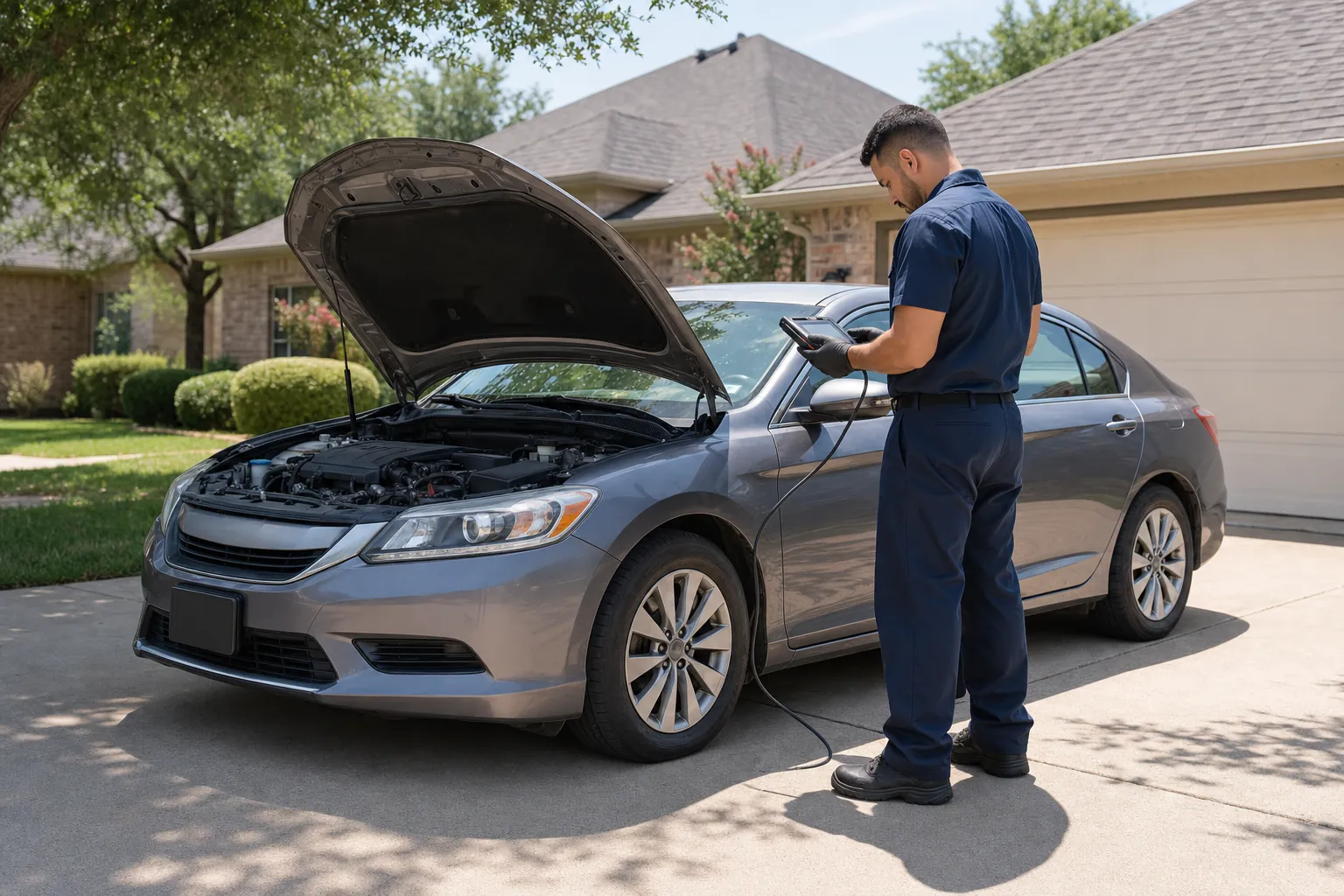
When a car cranks but will not start, the engine is turning over but never catching and running. That is an important clue. It means the starting motor is doing at least part of its job, so buying a starter based on the symptom alone is usually the wrong move. The next question is what the engine is missing once it begins to turn.
For a Dallas-Fort Worth driver stuck at home, work, or an apartment, the useful response is to make a few safe observations, stop repeated start attempts, and arrange the right kind of diagnosis. A normal crank can still come from several systems, including fuel delivery, ignition, air, sensor information, timing, or a vehicle security control. The sound and timing of the symptom help a technician start in the right place.
Quick Answer
If the engine cranks normally but will not start, do not assume the battery or starter is the problem. Note what happened before the no-start, avoid long cranking attempts, and book diagnostics when the cause is not confirmed.
First, make sure it really is a crank-no-start
The words people use for a no-start can mean different things. A no-crank problem means the engine does not rotate when you turn the key or press the start button. You may hear clicking, a single thud, or nothing. That puts the battery, battery connections, starter circuit, starter, gear-position switch, and related controls high on the list.
A crank-no-start problem is different. The engine spins at a normal or near-normal speed, but it does not fire up. You may hear a steady “ruh-ruh-ruh” sound without the engine ever catching. Because the engine is already turning, a starter replacement does not address the most likely question. Diagnosis has to look beyond the crank circuit.
Try to describe the symptom without diagnosing it yourself. Say whether the engine turns quickly, turns slowly, starts briefly and dies, has a warning light, or changed after a refueling stop, rainstorm, jump-start, or recent repair. That information is more useful than saying you think it needs a fuel pump, starter, battery, or sensor.

Do not keep cranking the engine
It is tempting to hold the key or start button longer when the car almost starts. Resist that urge. A few short attempts are enough to capture the symptom. Repeated or extended cranking can run the battery down, put extra heat into the starter, and make the original problem harder to identify. Once the battery weakens, a clear crank-no-start can turn into a second no-crank issue.
Stop immediately if you smell raw fuel, see smoke, notice a fluid leak, or are parked in a location that is unsafe to work around. If the engine starts and stalls, do not keep pumping the accelerator or adding starting fluid. Those shortcuts can create risks and do not prove why the vehicle failed to run.
A short phone video of the dash and starting sound can be helpful when the problem is intermittent. Take it only if you can do so safely from the driver's seat. The goal is to show what happens, not to create more failed start attempts.
Clues that help narrow the problem
The timing of the failure matters. A car that was running normally, then would not restart after a quick stop, has a different story from a car that was hard to start for several days. A no-start after an overheating event, a recent repair, a dead battery, heavy rain, or a refueling stop may point the inspection in a useful direction. It still does not prove the part that failed.
Pay attention to what happens after the engine first catches. If it starts for a second and then dies, mention that. If the engine cranks faster than usual, cranks unevenly, or has an unfamiliar mechanical sound, stop trying and report it. If a theft, key, or security message appears, take a photo of the exact message rather than assuming the fuel or ignition system is at fault.
It also helps to separate a warning light that appeared before the no-start from one that appears only because the key is on and the engine is off. A technician can interpret the full pattern with the vehicle information, but a driver who records the sequence gives the diagnosis a stronger starting point.
Common reasons an engine cranks but will not start
Fuel delivery: An engine needs the right amount of fuel at the right time. A failed fuel pump, restricted delivery, fuel-pressure problem, wiring concern, or a control issue can leave an engine cranking without starting. A refueling stop can be a useful timing clue, but it does not prove that the fuel pump or vapor system is responsible. Rise High's guide to a no-start after getting gas explains why the sequence matters.
Ignition and spark: Gasoline engines need a timed spark to light the fuel and air mixture. Spark plugs, ignition coils, wiring, sensors, and the vehicle's computer controls can all affect that process. The absence of a visible warning light does not rule these out, and a code scan by itself is not always enough to name the failed part.
Airflow and sensor information: The engine computer uses several inputs to decide how to start and run the engine. A sensor concern, intake-air issue, or electronic throttle problem may prevent a start or cause the engine to catch briefly and stall. The diagnostic path changes by vehicle, which is why generic online parts lists are a poor substitute for testing.
Timing or mechanical problems: If the engine cranks unusually fast, sounds uneven, or failed suddenly after an overheating or mechanical event, a repair shop may be the safer next stop. Internal engine concerns and timing-related repairs require a different level of inspection and may not be suitable for a mobile worksite.
Cranking is not the same as running
A car can have enough battery power to spin the engine while still lacking fuel, spark, correct sensor information, or another requirement to start. The symptom narrows the question, but it does not confirm a part.
What a battery or jump-start can tell you
A weak battery can make the engine crank slowly, briefly, or inconsistently. If the crank speed is normal, the battery is less likely to be the main explanation, but it is not automatically cleared. Battery condition, terminal connections, and charging history still matter because low voltage can affect modern vehicle electronics and the quality of the start attempt.
If a safe jump-start changes the symptom, write down exactly how. Did the engine crank faster? Did it start and keep running? Did it start briefly and die? Those outcomes mean different things. A jump that only improves crank speed points back toward the battery path. A vehicle that cranks the same with a good jump source but does not start needs a wider diagnostic look.
Do not keep using a jump-pack as a workaround for a problem that returns. A vehicle that repeatedly needs a jump may have a battery, charging, connection, or electrical concern that needs testing. For more on that distinction, read what to check when the battery seems good but the car will not start.

What a diagnostic visit checks
A proper crank-no-start diagnosis begins with the exact symptom and the vehicle's recent history. Depending on the make, model, and behavior, a technician may check battery voltage and connection quality, scan for relevant fault information, verify engine cranking speed, look for start-system or security messages, and test the systems that control fuel, spark, or sensor input.
The value is in testing the path before approving parts. A no-start can tempt a driver to replace a battery, starter, fuel pump, coil, or sensor based on the most familiar guess. That can become expensive fast and may still leave the car parked. Diagnostics separate a confirmed repair from a plausible theory.
Rise High charges $150 total for an on-site diagnostic visit when the cause is unclear. A confirmed repair visit starts with a $50 booking and travel fee before parts and repair labor. That difference matters when the vehicle cranks but will not run, because the first job is finding the fault, not choosing a part in advance.
Details to share before the visit
You do not need to troubleshoot the vehicle for the mechanic. You can help the visit begin efficiently by having the basic facts ready: year, make, model, engine if known, current location, and what happened immediately before the problem started. Mention whether the car stalled while driving, stopped after getting fuel, had a recent battery or alternator replacement, or showed a warning message.
Also describe the work area. A level driveway, apartment space, or office lot can be suitable for many diagnostic visits. A busy roadway, poorly lit shoulder, steep driveway, or tight garage may not be. Rise High's appointment process explains why the symptom, vehicle, and parking conditions are all part of choosing the right visit.
- Say whether the engine cranks normally, slowly, briefly, or starts and stalls.
- Share what happened before the no-start, including recent warning lights, repairs, or a refueling stop.
- Let the technician know whether a safe jump-start changed the crank speed or outcome.
- Provide the exact location and any gate, garage, parking, or access restrictions.
- Stop repeated start attempts after you have noted the symptom.
When a shop or tow is the better choice
Mobile diagnostics are useful when the vehicle is parked safely and the issue can be evaluated on site. A repair shop is often the better answer when testing points to extensive wiring work, internal engine trouble, major timing repairs, advanced module or security programming, major disassembly, or equipment that needs lift access. A shop is also safer when the parking location itself is unsafe for service.
If the no-start happens with an open safety-recall notice, use NHTSA's VIN recall lookup before paying for work that might relate to a manufacturer campaign. When you approve any inspection or repair, make sure the scope and cost are explained clearly. The Texas Attorney General's car repair guidance recommends clear written authorization before work begins.

How Rise High helps with a crank-no-start
Rise High Mobile Mechanics helps Dallas-Fort Worth drivers with on-site diagnostics, battery and charging checks, electrical concerns, no-start symptoms, and mobile-friendly repairs for gasoline and hybrid passenger vehicles. When the engine cranks but will not start, the right first step is to identify whether the problem involves fuel, ignition, air, sensor information, vehicle controls, or something that needs a shop.
For an unknown no-start, start with diagnostics. If testing confirms a repair that fits the vehicle and a safe worksite, Rise High can explain the next step. If the fault needs a repair shop, you get a clear answer before spending money on the wrong repair visit. Drivers who hear clicking instead of normal cranking can also read what a clicking no-start may mean.
Get the No-Start Tested Where It Sits
Call or text with the vehicle details, location, and what happens during a start attempt. Rise High can help you choose diagnostics or a confirmed repair visit.
Frequently asked questions
What does it mean when a car cranks but will not start?
It means the starter is turning the engine, but the engine is not catching and running. That changes the diagnostic path. The issue may involve fuel delivery, spark, airflow, sensor information, timing, or an anti-theft or control-system concern rather than the starter itself.
Will a bad battery cause a car to crank but not start?
A weak battery can cause a slow or inconsistent crank, but an engine that cranks normally is not the classic sign of a dead battery. A battery or charging issue can still be part of the picture, so testing is more useful than assuming the battery is cleared or definitely at fault.
Should I keep trying to start a car that cranks but will not start?
No. One or two short attempts are enough to note the symptom. Long or repeated cranking can drain the battery, overheat the starter, and make it harder to separate the original problem from a new low-battery condition.
Should I book a starter replacement if my car cranks but will not start?
Usually no. If the engine cranks, the starter is already turning it. Book diagnostics when the cause is unknown. A confirmed repair visit makes more sense after testing identifies the actual failed part and the repair fits a safe mobile worksite.
Related posts
Can a Mobile Mechanic Replace a Starter?
When a mobile starter replacement makes sense, why testing comes first, and when a Dallas-Fort Worth repair shop is the better call.
Car Won't Start but Battery Is Good? Next Steps
What to check when your car will not start but the battery seems good, plus when Dallas-Fort Worth drivers should book mobile diagnostics.
Car Clicks but Won't Start? What to Check First
A car that clicks but will not start may have a battery, cable, starter, relay, or safety-switch problem. Learn what the sound can tell you before booking service.
Car Won't Start After Getting Gas? What to Check
A car that will not start after getting gas can be a coincidence or a fuel-vapor issue. Learn what to note, what not to do, and when diagnostics make sense.